Frequently Asked Questions
The most-asked questions about classical philosophy & rhetoric.
What does 'classical philosophy & rhetoric' actually refer to?
It is the body of thought produced in the ancient Greek and Roman worlds, roughly from the 5th century BCE through the 5th century CE, tackling questions of ethics, metaphysics, politics, and persuasive speech. The label 'classical' marks this foundational period before the medieval and modern eras.
Who are the central figures everyone keeps mentioning?
On the Greek side, Socrates, Plato, and Aristotle form the foundational trio, while in Rome Cicero and Quintilian dominate the rhetorical tradition. Stoics like Epictetus and Marcus Aurelius, plus skeptics such as Sextus Empiricus, round out the major voices.
Where should a complete beginner start reading?
Plato's dialogues—especially the Apology, Crito, and Republic—offer the most accessible entry point because they read almost like extended conversations. For rhetoric, Cicero's 'On Invention' or a selection of his courtroom speeches gives a feel for the art in practice.
What's the difference between philosophy and rhetoric in this tradition?
Philosophy aims at truth and understanding through reasoned argument, while rhetoric is the craft of persuading an audience, often in a courtroom or assembly. In practice the two overlapped heavily; Aristotle, for instance, wrote both the Nicomachean Ethics and the Rhetoric as companion disciplines.
What are the 'five canons of rhetoric'?
They are invention (finding arguments), arrangement (ordering them), style (choosing language), memory (delivering from recall), and delivery (voice and gesture). The framework was systematized by Cicero and later refined by Quintilian in his Institutio Oratoria.
What exactly is the Socratic method?
It is a dialogue technique in which a questioner asks a series of probing questions to expose contradictions in the respondent's assumptions, steering the conversation toward a clearer definition of a concept. It appears throughout Plato's early dialogues and became the standard pedagogical tool in Western education.
What period does 'classical' cover, and why does the cutoff matter?
Scholars generally place the era from the pre-Socratics (Thales, c. 624 BCE) through the fall of the Western Roman Empire (476 CE). The boundary matters because it separates the original texts from the medieval commentaries and Renaissance revivals that followed.
What are some of the most famous debates or 'moments' in the field?
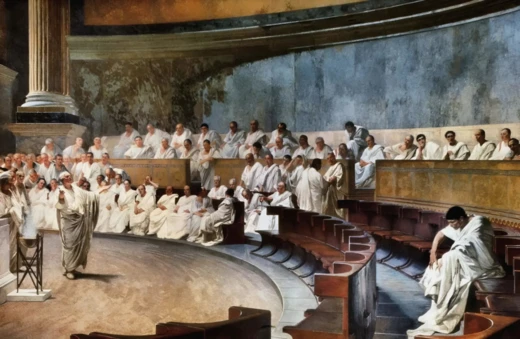
The trial and execution of Socrates in 399 BCE, as recounted in Plato's Apology, is often treated as the defining event of the philosophical tradition. In rhetoric, Cicero's prosecution of Verres and his Catiline Orations are the set pieces most anthologies open with.
How do Greek and Roman contributions differ in emphasis?
Greek thinkers tended to focus on first principles—being, knowledge, the good—while Roman writers leaned toward practical application in law, politics, and public speaking. That said, Roman philosophers like Seneca and Marcus Aurelius absorbed Greek Stoicism and added their own meditative and ethical layers.
Are these texts still relevant, or are they just historical artifacts?
Core questions about justice, the good life, and effective communication haven't changed, which is why modern political speeches, legal arguments, and ethical debates still echo Plato, Aristotle, and Cicero. The tradition also underpins contemporary disciplines like political science, law, and communication studies.